

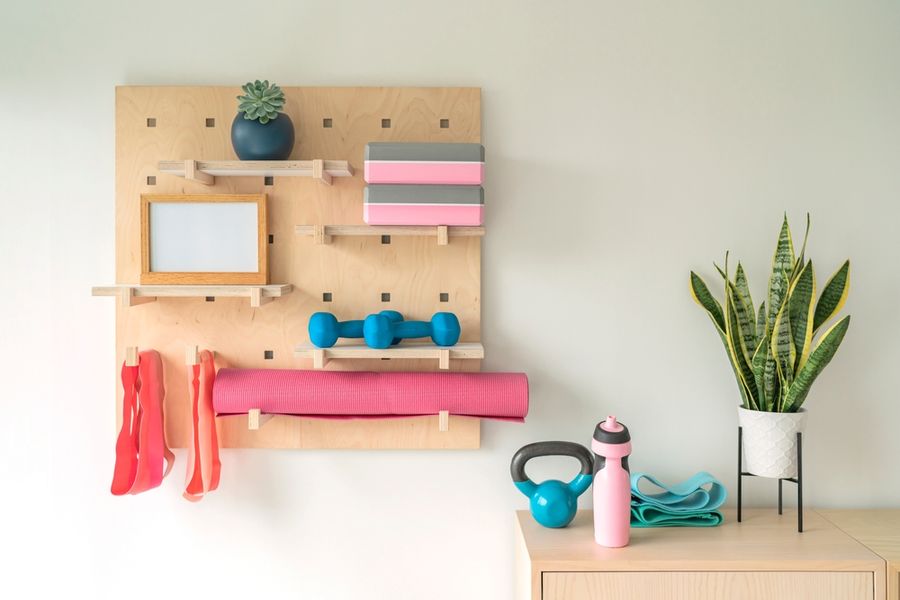
Creating a workout space in a small home is less about finding an empty room and more about using one part of your existing space deliberately. A bedroom corner, living-room wall, or section of a home office can work if equipment is easy to access and just as easy to put away. With a clear footprint, compact gear, and sensible storage, you can create a fitness area without allowing exercise equipment to dominate the rest of your home.
Start With a Defined Workout Footprint
Before buying equipment, decide exactly where exercise will happen. A compact home gym does not necessarily require much open floor space; a basic setup built around a mat and small equipment can work within an area of roughly 6 by 6 feet.
Test your chosen location before committing to it. Put down a mat and move through the exercises you expect to do most often. Extend your arms overhead, step forward and backward, lie down, and check whether furniture, ceiling fixtures, or walls interfere. The goal is not to create the largest possible gym but to establish a dependable area you can clear quickly whenever you want to exercise.
If the room serves another purpose, establish boundaries visually. A mat, small rug, storage basket, or narrow shelving unit can identify the workout zone without requiring permanent construction.
Choose Equipment That Replaces Multiple Pieces
Small homes reward equipment that performs several jobs. Instead of collecting individual dumbbells in different weights, consider an adjustable set. Some compact adjustable dumbbells can replace multiple pairs of traditional weights; the PowerBlock Sport 24, for example, replaces eight separate pairs while retaining a relatively small footprint.
Apply the same principle to every purchase. Before bringing something home, ask whether it expands your workouts enough to justify the storage it requires. A bulky piece of equipment used for one movement may be a poor fit, while a mat, adjustable weights, or a versatile bench could support several exercises.
Avoid filling the space immediately. Starting with one or two useful pieces makes it easier to discover what your routine actually lacks rather than buying equipment based on an imagined workout plan.
Use Resistance Bands for Easy-to-Store Strength Training
Resistance bands are particularly well suited to small spaces because they are portable, provide adjustable resistance, and can be incorporated into at-home workouts without requiring a rack or dedicated machine. Several bands can usually be stored together in a small basket, bag, or drawer.
Long resistance bands can support exercises such as rows, presses, and arm movements, while smaller loop bands are useful for many lower-body exercises. They also combine easily with bodyweight movements, which helps keep the amount of equipment in the room under control.
Give bands a dedicated storage location instead of dropping them onto the floor after each workout. Hooks inside a closet, a small basket, or a drawer near the workout area can keep different resistance levels together and make them easy to find.
Take Advantage of Doors and Vertical Space
When floor space is limited, look upward. Wall hooks, narrow shelving, over-the-door storage, and baskets can keep lightweight accessories from spreading across the room. Rolled mats can stand vertically, resistance bands can hang from hooks, and small items such as sliders or jump ropes can stay together in a basket or drawer.
Doors can become useful workout space as well. The TRX Door Anchor fits over a solid door and provides an anchoring point for compatible TRX suspension-training straps. It is also lightweight and packable, making it practical for a workout setup that needs to disappear when exercise is over.
Keep heavier equipment such as dumbbells low to the ground on a stable surface rather than trying to incorporate everything into vertical storage. The point is to reserve floor space for movement while giving smaller equipment a predictable place to go.
Keep the Floor Clear and Comfortable
Your dedicated area should be ready for movement, not filled with equipment you have to navigate around. Keep the center of the workout zone open and move stored gear into place only when you need it.
A mat can define the exercise area while adding a layer between you and a hard floor. Choose one appropriate for the movements you actually perform rather than assuming the thickest option is automatically better. If your workouts involve jumping or other high-impact movements, consider how sound travels through the building as well, particularly in an apartment or upstairs room.
After each session, return equipment to its assigned location. Resetting the space immediately prevents a temporary home gym from gradually becoming permanent clutter.
Make Starting the Workout Almost Effortless
Convenience matters in a small home because setup can easily become an excuse to skip exercising. If starting a workout requires moving a coffee table, finding missing bands, retrieving weights from several closets, and untangling cables, the space is working against you.
Keep frequently used equipment together. Store your mat beside the workout area, place accessories in one container, and keep weights somewhere accessible but secure. If furniture must move, decide in advance where it goes during exercise.
You can also keep a few familiar routines available so you do not need to invent a workout every time. Match those routines to the equipment stored in the space, making the transition from “living room” to “workout area” as short as possible.
Build a Fitness Space That Can Disappear Again
A successful small-home workout area does not need to look like a gym all day. It needs enough clear space to move safely, a few pieces of versatile equipment, and storage that makes resetting the room simple.
Start with the floor space you already have, then add equipment only when it solves a real need. Adjustable weights, resistance bands, compact accessories, and carefully chosen vertical storage can provide plenty of flexibility without overwhelming the room. When everything has a designated place, your workout space can be ready when you need it and disappear when you do not.