
Practicing yoga at home is convenient, but a living-room setup can expose small limitations in flexibility, balance, comfort, and reach. The right props can make poses easier to approach without turning your practice into an equipment-heavy project. Blocks, straps, bolsters, blankets, and knee pads each solve a different practical problem, giving you more ways to adjust poses to your body and your space while keeping your routine simple enough to maintain.
1) Yoga Blocks Can Bring the Floor Closer
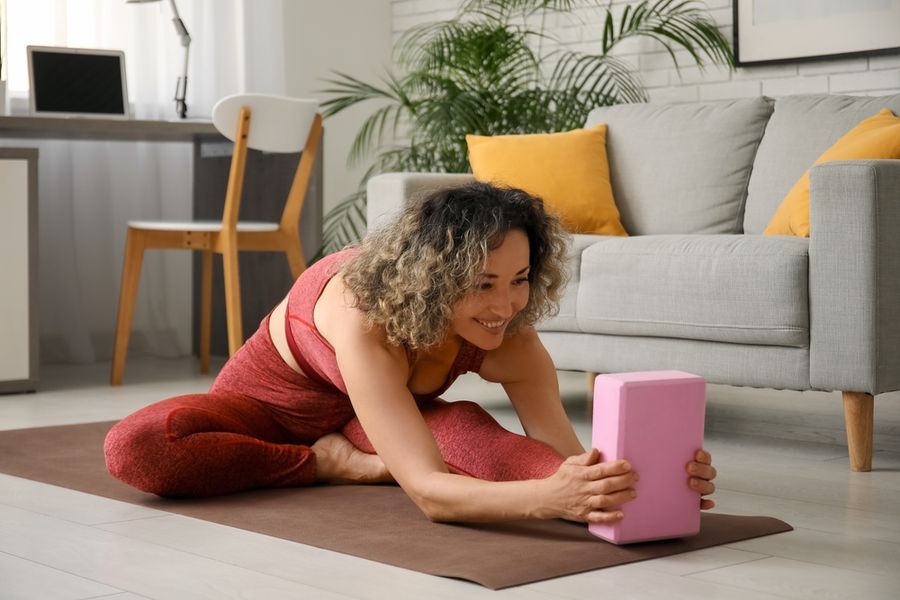
Yoga blocks can reduce the distance between your hands and the floor in standing or bending poses. That extra height can make positions such as triangle pose or a forward fold easier to approach without forcing your range of motion. Blocks can also provide support in seated or reclined positions and may be placed between the thighs in bridge pose as a physical reference point for alignment.
Foam and cork blocks are both common, but the most useful feature is adjustability. Turning a rectangular block onto different sides gives you multiple height options, so you can change the amount of support from pose to pose. Blocks can be useful for beginners while remaining practical as flexibility and strength change over time.
2) A Yoga Strap Helps Extend Your Reach
A yoga strap acts as an extension of your arms when tight muscles or limited range of motion make it difficult to reach your feet or connect your hands comfortably. In a seated forward fold, looping a strap around the feet can let you work with the stretch without straining to grab your toes. Straps can also help with shoulder-opening movements and poses that involve reaching behind the back.
The goal is not to use the strap to pull yourself aggressively into a deeper position. It works as an adjustable connection point that lets you change distance gradually. Yoga straps can be used long or looped into different sizes, allowing one prop to work across several types of poses while taking up very little storage space.
3) A Bolster Supports Slower, Restorative Poses
Bolsters are often used in restorative and yin-style practices, where positions may be supported for longer periods. Placing a bolster beneath the knees, hips, torso, or along the spine can provide a broad, cushioned support surface. In final relaxation, for example, a bolster under the knees can provide additional support while the body settles into the position.
A bolster can also suit days when you want a gentler session rather than an active flow. Firmness and shape affect how the prop supports different positions, and ordinary pillows can sometimes substitute when a dedicated bolster is unavailable.
4) A Folded Blanket Adds Flexible Cushioning
A yoga blanket can be folded, rolled, or layered, making it one of the most adaptable props. Folded beneath the knees, it can add cushioning during kneeling poses. Placed beneath the hips, it can make cross-legged sitting more comfortable, while a rolled blanket can support other parts of the body in restorative positions. Blankets can also provide warmth during relaxation or meditation.
Unlike a fixed-size prop, a blanket lets you change the amount of height or padding by adjusting the fold. It can therefore be useful when you want a softer or more precisely sized support than another prop provides. Both folded and rolled blankets are used to modify support according to the position and the practitioner’s needs.
5) Knee Pads Add Cushioning Where You Need It
If kneeling is the part of yoga that causes discomfort, targeted cushioning can provide extra padding directly beneath the knees. Cushioned yoga supports can be used to pad and elevate the knees or wrists, while additional cushioning may also be helpful during floor-based positions.
A small knee pad is a more targeted solution than adding thickness beneath the entire practice area. It can be positioned where extra cushioning is needed during kneeling portions of a routine and removed when it is no longer necessary. For someone who repeatedly reaches for folded towels or extra padding during kneeling poses, a dedicated support can be a practical addition to an at-home setup.
Build Your Prop Kit Around Real Needs
You do not need every yoga accessory at once. Start with the limitation that repeatedly interrupts your practice. Blocks can help when the floor feels too far away, a strap can extend your reach, a bolster can support restorative positions, a blanket can add flexible cushioning, and a knee pad can address pressure during kneeling. Props can be used to support alignment, stretches, stability, and a greater sense of security while practicing.
A useful home setup is one you will actually keep using. Choose props that address recurring difficulties instead of filling the room with equipment, and become familiar with how each one works before incorporating it into more demanding poses. A handful of well-chosen tools can give you more ways to adapt your yoga routine from one session to the next without making the practice unnecessarily