

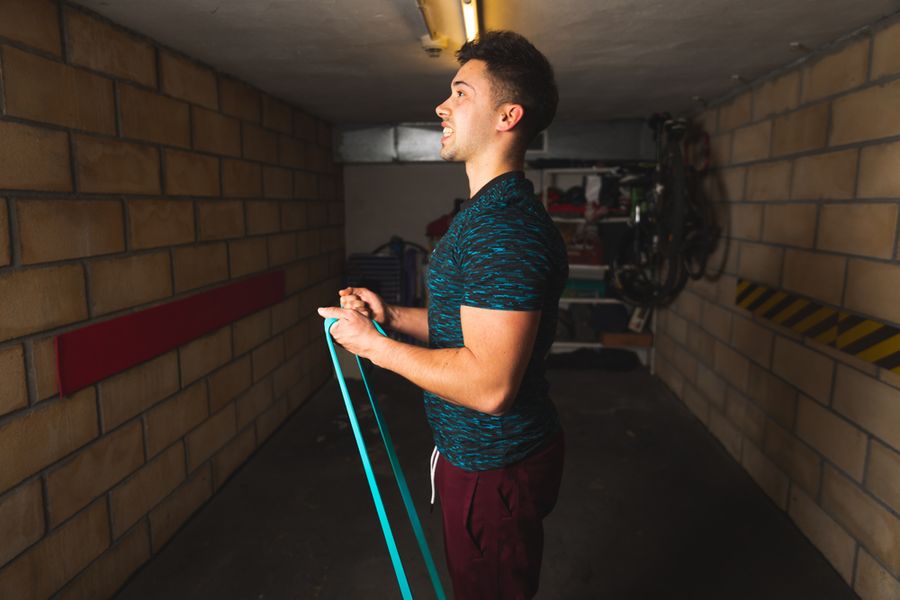
A home gym does not need a dedicated room, a rack of weights, or bulky cardio equipment. For apartment dwellers and anyone sharing limited living space, compact fitness tools can provide plenty of workout variety while disappearing into a closet, drawer, or corner afterward. The most useful options combine versatility with straightforward storage, allowing you to build strength, add cardio, or work on mobility without permanently rearranging your home around exercise equipment.
Resistance Bands Pack a Lot of Versatility Into a Small Package
Resistance bands are among the easiest fitness tools to store because a complete set can fit inside a small bag or drawer. They can provide adjustable resistance for upper-body, lower-body, and core exercises, and they work well for both home and travel workouts. A set with several resistance levels also makes it possible to change the challenge depending on the exercise.
Bands are particularly practical when your workout space needs to become a living room again as soon as you finish. Exercises such as rows, chest presses, lateral walks, curls, and leg extensions require little more than enough room to move safely. Loop bands are especially compact, while longer bands with handles or anchor attachments can expand the range of exercises available.
Adjustable Dumbbells Replace a Larger Weight Collection
Traditional dumbbells become difficult to justify when floor space is limited because adding resistance usually means adding another pair. Adjustable dumbbells approach the problem differently by combining several weight settings into one compact unit. Some current models, like the PowerBlock Sport 24, replace multiple pairs of traditional dumbbells while occupying the footprint of a single adjustable set.
That makes them particularly useful for people who want conventional strength training without building a full weight rack. Squats, presses, rows, lunges, curls, and other familiar dumbbell exercises can all fit into an at-home routine. The trade-off is that adjustable models are still relatively heavy pieces of equipment, so they need a stable storage location even though their overall footprint is small.
A Suspension Trainer Turns a Doorway Into Workout Space
A suspension trainer takes advantage of something most homes already have: a sturdy anchoring point. Door-compatible systems can be attached using a dedicated door anchor, while some designs can also be secured around appropriate outdoor structures. Compact suspension systems are designed to pack away into a small bag when the workout is finished.
The straps allow you to use your body weight as resistance for movements such as rows, presses, squats, lunges, and core exercises. Changing your body position can alter how demanding certain movements feel. The main limitation is setup: the anchor and door or support point must be appropriate for the system, and following the manufacturer's installation and safety instructions matters more than simply finding the nearest doorway.
A Jump Rope Delivers Cardio Without a Machine
A treadmill or stationary bike requires a permanent chunk of floor space. A jump rope can provide cardiovascular exercise while taking up barely any storage room. Jumping rope can raise your heart rate, challenge coordination and balance, and be incorporated into shorter cardio sessions or combined with strength training.
Storage may be easy, but workout space deserves more consideration. You need enough overhead and surrounding clearance to swing the rope without striking furniture, lighting fixtures, or other objects. Apartment residents may also need to consider downstairs neighbors and flooring. Outdoor patios, garages, driveways, and other suitable surfaces can make a jump rope much more practical when indoor clearance is tight.
Exercise Sliders Make the Floor Part of the Workout
Exercise sliders are small discs designed to move across compatible flooring while your hands or feet remain positioned on them. They require virtually no dedicated storage space and can often be tucked into the same drawer or basket as resistance bands. Their simplicity makes them particularly appealing when you do not want another piece of equipment occupying a visible corner of the room.
Sliders can add movement to exercises such as mountain climbers, lunges, plank variations, and hamstring curls. Because your hands or feet can travel along the floor rather than remaining fixed, familiar bodyweight movements can feel noticeably different. Before starting, check that the slider material suits your flooring and begin with controlled movements rather than immediately trying faster repetitions.
Build a Small-Space Gym Around the Exercise You Actually Enjoy
The most practical compact fitness tool depends on what you want to do. Resistance bands offer exceptional portability, while adjustable dumbbells make more sense if traditional weight training is the priority. Suspension straps provide another approach to strength work, a jump rope handles cardio without a machine, and sliders add variety without demanding meaningful storage space.
There is little benefit in buying five compact tools only to create a different kind of clutter. Start with one option that matches the workouts you already enjoy or genuinely want to learn. Give it a dedicated storage location and build a few repeatable workouts around it. A small home can still support a varied exercise routine when the equipment earns its space instead of simply occupying it.